
Urikkiri (oo-ree-KEE-ree)
noun
1 : a Korean phrase meaning “among ourselves” or “just between us.”
2 : a deep sense of communal belonging or unity based on shared identity, mutual support, and collective experience.
I found my mother's voice tucked away in a drawer.
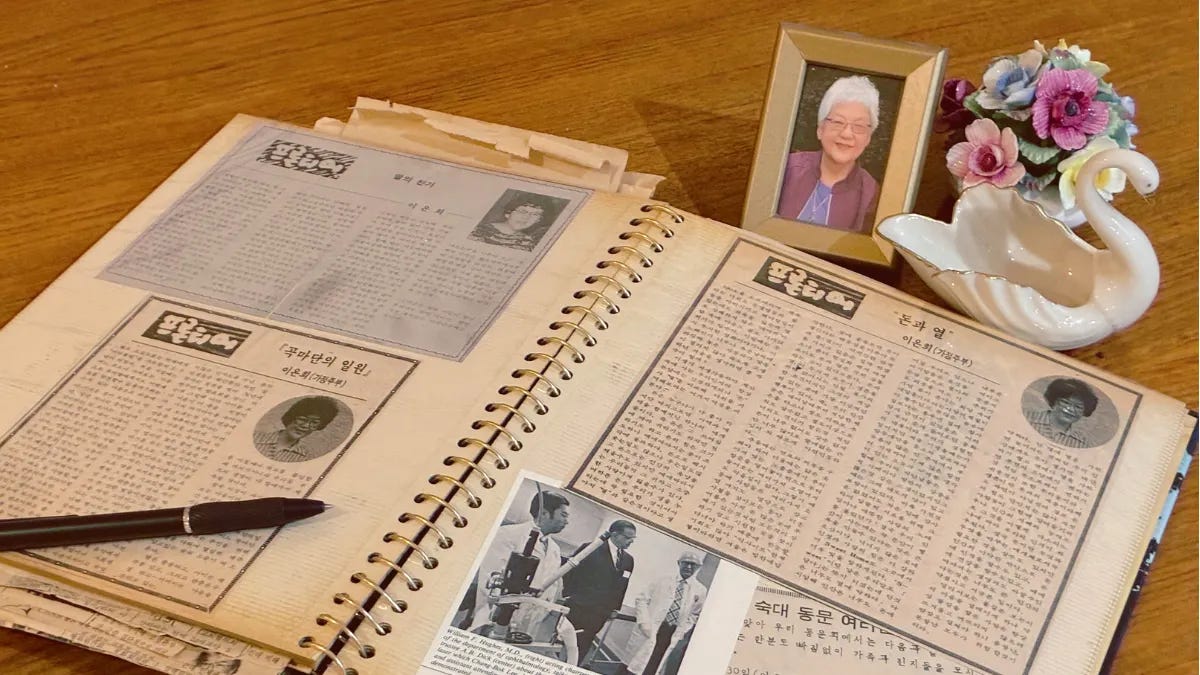
Urikkiri began with forty-two essays my mother wrote for Chicago’s Korean newspapers, Korea Daily News (JoongAng Ilbo) and Korea Times (Hankook Ilbo), from the 1980s through the turn of the millennium. Although her words reached thousands of Korean immigrants, I never read them. Written in a language I couldn’t understand, they remained a mystery to me for decades.
Years later, after I had become a wife and a mother myself, I couldn’t stop wondering who my mother had been when she wrote those essays. Whenever I asked about her writing, she brushed it aside as old newspaper columns—not worth revisiting.
Then one day, I discovered a scrapbook tucked away in a drawer, filled with carefully preserved newspaper clippings. Without telling her, I had them translated.
As I read her essays, I came to know a version of my mother I had never known—thoughtful, observant, vulnerable, and resilient. Between her words were the quiet realities of immigrant life, the challenges of building a home between two cultures, and the hopes and fears she rarely spoke aloud. For the first time, I wasn’t simply reading my mother’s writing. I was allowing her to tell me who she was.
That discovery eventually became Urikkiri.
As my understanding of my mother deepened, I began to wonder how others might experience her stories. I believed Asian American artists who, like me, had grown up navigating multiple cultures would recognize the quiet details—the family dynamics, the unspoken expectations, and the small moments that often go unnoticed. Their lived experiences wouldn't change my mother's stories; they would deepen the conversation around them.
Today, each issue of Urikkiri pairs one of my mother’s translated essays with original work by a contemporary Asian American artist. Together, words and art create a conversation across generations, cultures, and lived experiences, inviting readers to discover their own families, memories, and questions within the story.
I’m grateful my mother knew I was bringing her essays back to life before she passed away. Through her words, I found not only a deeper understanding of her, but also a deeper understanding of myself.
If you’ve ever wished for one more conversation with a parent, wondered who they were before you knew them, explored your family history, or questioned how well we can ever truly know the people we love, you’re in the right place.
What’s Next….
We’ve launched Issue 01: Poor Answer, but the story doesn’t stop here. Three incredible artists are locked in for our upcoming releases:
Nearsightedness
Illustrated by Victoria Goite | @victoriagoite.tattoo | @goite.art | December 2026
My mom reflects on how true vision comes not from our eyes, but from the heart.
My Mossy Life
Illustrated by Jessica Herrera | March 2027
After years in a new land and domestic life, my mom finds her voice again.
Circus Performer
Illustrated by Hero See | @heropaulsee | June 2027
My mom compares parenting to a circus act of love, pressure, and constant anxiety.
Join the Urikkiri community.
Choose the subscription that’s right for you, or collect individual print editions.
Have a question or interested in collaborating? Email: partnerships@urikkiri.com