
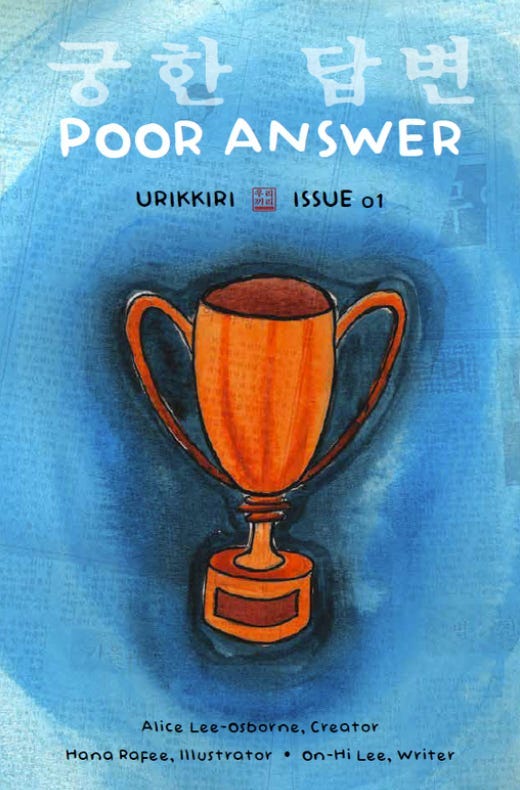
Originally published in a Chicago Korean newspaper in the 1980s, “Poor Answer” explores my mother’s experience raising a Korean American family as an immigrant in the United States. Through her daughter, she reconsiders the cultural values she inherited and discovers when patience gives way to speaking up.
Unlock the full digital edition with a subscription, or collect individual print issues.
Inside the Issue
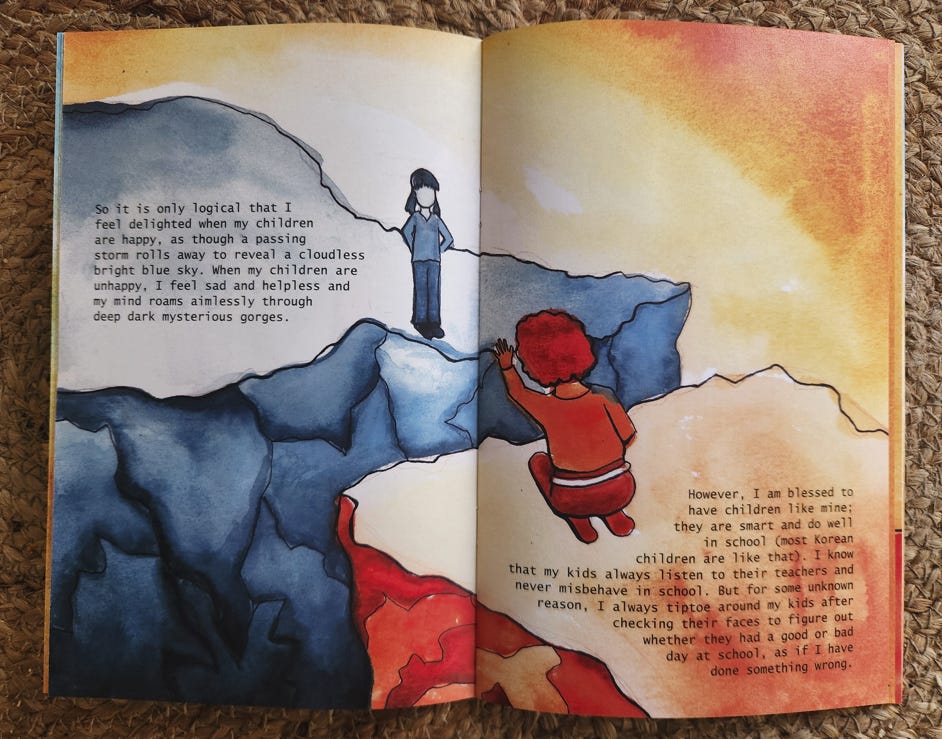
The artwork in this issue tells as much of the story as the words do. This illustration is one of my favorites. Which one was yours?
Original Article
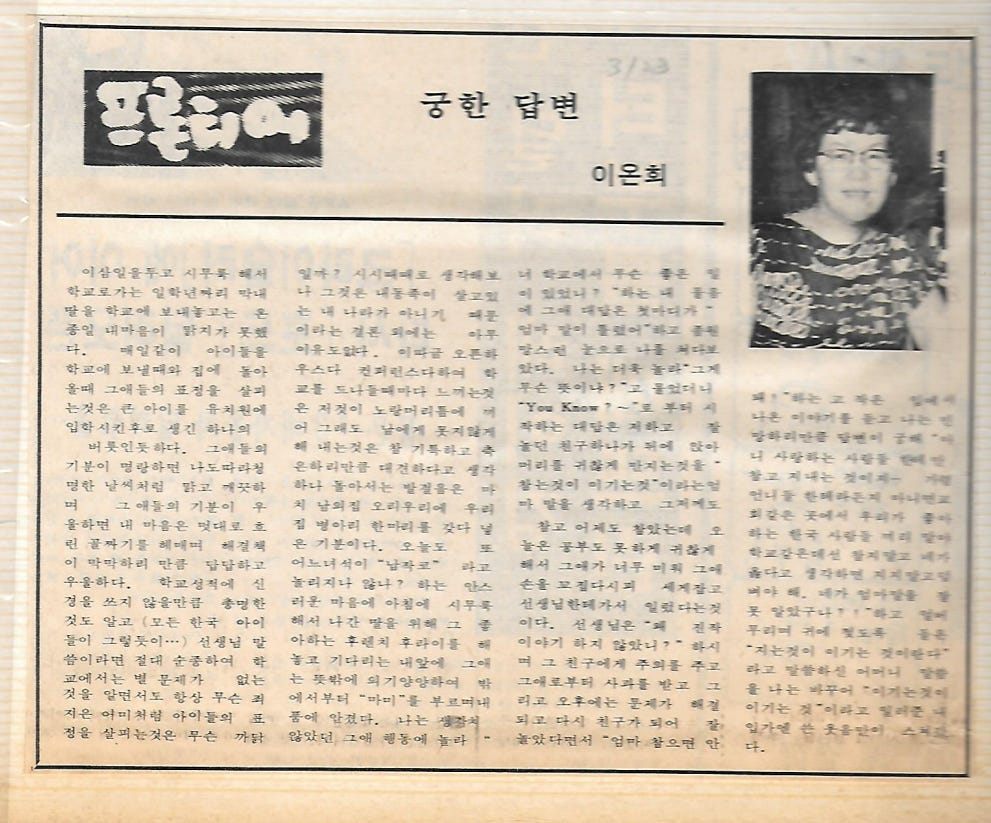
Full English Translation of “Poor Answer”
By On-Hi Lee
There is nothing more joyful or important or inspirational, nothing that fulfills love and compassion more than being a mother. Motherhood taught me patience and humility. My spirits cannot be lifted further when my children are happy and cheerful, and nothing makes me more disheartened than their sadness. Motherhood means going through life with a full spectrum of emotions—joy, pride, appreciation, anticipation, tearfulness, fear, worry, anxiety, and much more.
My youngest daughter, a first-grader, has been a little gloomy for the past few days. Sending her to school this morning without knowing what was bothering her made me feel heavy-hearted all day. The process of reading my children’s facial expressions before and after school has become a ritual ever since my oldest started kindergarten. If anyone asked me what I most wanted for my children, my answer would unshakably be “All I want is my children to be happy.” However, the truth is that I cannot make that happen for them as they grow and become independent-minded and free-thinking individuals who face their own challenges in their lives.
So it is only logical that I feel delighted when my children are happy, as though a passing storm rolls away to reveal a cloudless bright blue sky. When my children are unhappy, I feel sad and helpless and my mind roams aimlessly through deep dark mysterious gorges. However, I am blessed to have children like mine; they are smart and do well in school (most Korean children are like that). I know that my kids always listen to their teachers and never misbehave in school. But for some unknown reason, I always tiptoe around my kids after checking their faces to figure out whether they had a good or bad day at school, as if I have done something wrong.
I cannot think of any reason why I feel this way around my children, though I have questioned it often. Is it because I am not raising my children in my own country, where people look like me, speak the same language, and share cultural uniqueness? Is it because I worry that my children could be unfairly treated in school because of how they look? Whenever I go to open houses and parent-teacher conferences at their school, I cannot stop thinking about how proud I am of my children. My kids compete with yellow-haired kids who live in the land of their own heritage and do as well as any other kid in school. But when I walk out of that school, I always have the feeling that I am sending my kids to a place that exacerbates their visual differences from other kids, like baby chicks in a yard full of ducklings.
I could not figure out why my little girl was so moody this morning. Maybe some little rascal called her a “flat-nose.” It hurts my feelings even to think about it. How could I know? I prepared French fries, her favorite snack, to cheer her up a little. But I heard her very excited voice even before she came to the door. She called “Mommy!” as loud as she could and jumped into my arms when I opened the front door. It was an unexpected, pleasant surprise. So I asked her, “Did you have a good time at school?” The tiny little innocent face looked at me with a look of blame and said, “Mommy, you were wrong.” Her answer made me even more awed and curious. So I asked her, “What are you talking about, honey?” She began her story with, “You know…”
So her story goes—the student sitting right behind her in class, who used to be a good friend of hers, had been bothering her for the last few days. The student pulled her hair when my daughter tried to focus on her schoolwork. However, she was tolerant of the other student because she had remembered something I said: “Being patient with others is winning.” I know this is a funny way to word it, but what I meant was that being patient with others will make you a better person. My daughter continued, “I was being patient with the kid yesterday and the day before, but I could not do it anymore today.” It seemed she had had enough of this student. “I was so annoyed and angry because I could not do any schoolwork, so I grabbed her by the hand, almost pinched her hand, and dragged her to the teacher’s desk.”
She explained to her teacher what had been going on between her and the kid for the last few days. Her teacher told her sympathetically that my daughter should have approached her sooner. The teacher advised the kid not to bother my daughter anymore, and she got an apology from the kid. Afterwards, it seemed everything was fine again. She said they played together nicely in the afternoon.
From her tiny cute mouth, she said, “Mommy, don’t be patient.” I take this to mean: “Being patient with others is not always the best choice.” And my little girl was right. I felt uneasy—not because of what she said to me but because my little girl had tried to endure something she did not like because of what I had told her. I gathered my thoughts and looked at her face with a regretful heart and told her, “What I meant was that we should be patient with people who we love and adore, like your sisters and the Korean people we meet in our church. Sometimes, you need to speak up for yourself when you think something is not fair instead of just accepting it. What happened today at school is a good example of that. I am sorry that my unclear words led you to misunderstand me.” That was how our conversation ended. Many times, I thought I was teaching my children valuable life lessons similarly to how my parents once taught me. However, in a deeper sense, I realized it is the other way around.
I cannot recall how many times my mother had told us, “Losing is winning.” I took this to mean: “Giving up little for those around us makes us better people.” I wanted to teach my children the lessons my mother had taught me. I know that my mother would want that too. But I also know that she would want her granddaughter to speak up for herself when she needs to. So, if anyone asks, “Is it better to say ‘Winning is winning’ sometimes?”, my answer is a sincere “Yes” with a profound smile on my face.
Upcoming Zines….
Nearsightedness
Illustrated by Victoria Goite | @victoriagoite.tattoo | @goite.art | December 2026
My mom reflects on how true vision comes not from our eyes, but from the heart.
My Mossy Life
Illustrated by Jessica Herrera | March 2027
After years in a new land and domestic life, my mom finds her voice again.
Circus Performer
Illustrated by Hero See | @heropaulsee | June 2027
My mom compares parenting to a circus act of love, pressure, and constant anxiety.
Join the Urikkiri community.
Choose the subscription that’s right for you, or collect individual print editions.
Have a question or interested in collaborating? Email: partnerships@urikkiri.com